CALL NOW
☰
After a serious motorcycle crash, the insurance company treats the rider like the problem before the facts are even collected. You need a lawyer who rides. Scranton Law Firm is led by one, and we have represented injured riders and their families across Northern California for more than 50 years, from the Bay Area and the Delta to Sacramento and the valley. Free consultation. No fee unless we win.
Your call is answered, day or night. No voicemail, no pressure, no cost to ask.
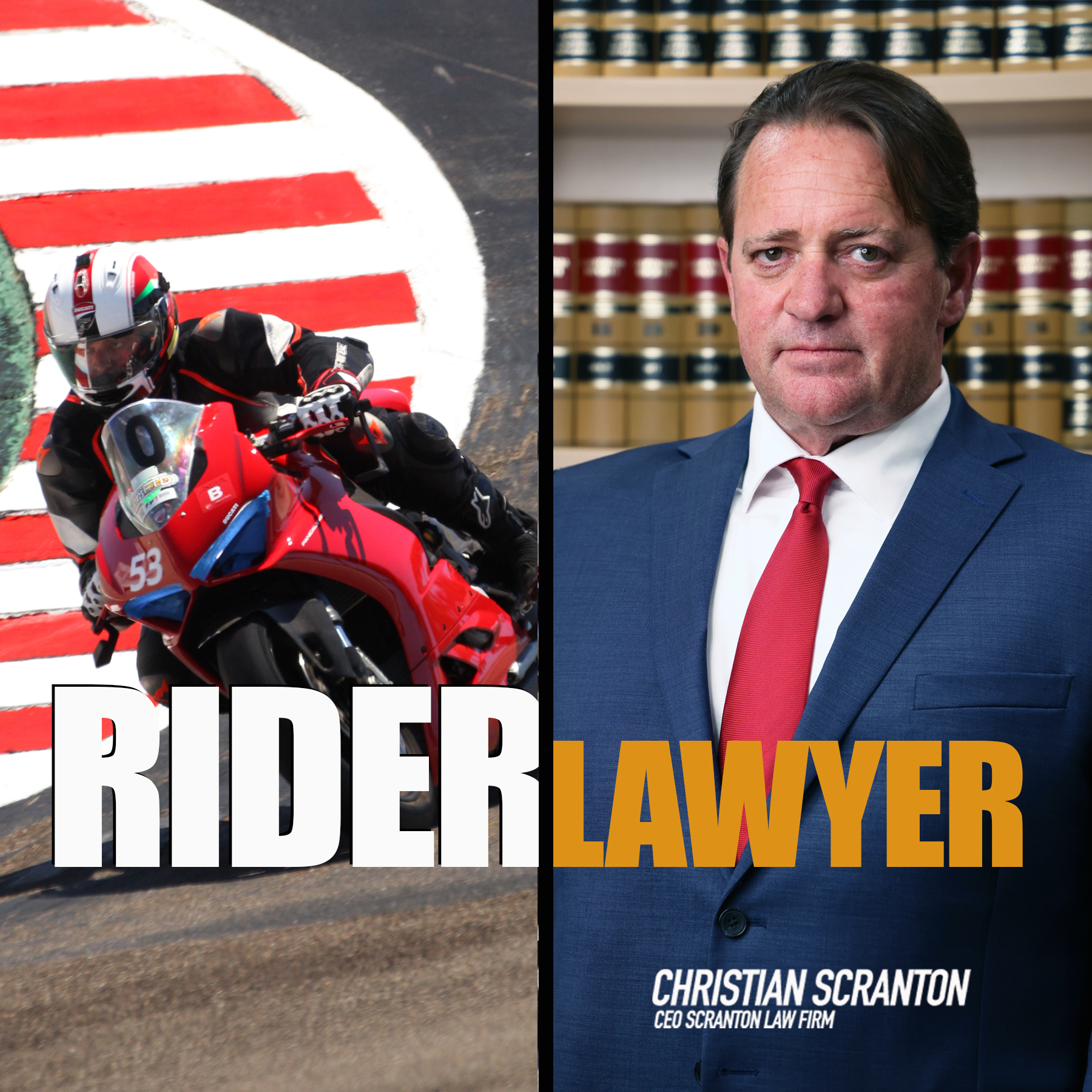
Chris Scranton has been riding most of his life, from the street to the track to the trail, from Bay Area backroads to the Baja 1000. He has also been through the other side of it: multiple surgeries, months of rehab, and the long stretch of not being able to do what you love.
That matters in your case for a practical reason. An adjuster’s first move is to assume the rider was reckless. A lawyer who rides knows what actually happens at a left-turn intersection, in a lane split, or on a road with gravel in the curve, and knows how to prove it.
The firm also puts time and money back into the riding community it represents. Scranton Law Firm sponsors Fun Track Days and FP1 motorcycle track days, and backs its own rider team, Team SLF Moto.
The first hours shape the insurance claim. Protect your health first, then protect the evidence before it disappears.
Get medical help even if adrenaline is masking symptoms. Internal injuries and concussions show up late.
Vehicles, skid marks, lane position, debris, signals, road defects, and your visible injuries.
Names and numbers before people leave the scene. Independent witnesses beat rider bias.
Helmet, jacket, gloves, boots, camera footage, and damaged parts. Do not repair or throw anything away.
Do not give the insurance company a recorded statement before you understand the legal impact.
Before camera footage, vehicle data, and scene evidence are gone. 800-707-0707.
Adjusters assume the rider was speeding, lane splitting unsafely, or taking unnecessary risks. We counter assumptions with crash evidence, witness statements, and reconstruction work.
Spinal injuries, traumatic brain injuries, fractures, road rash, amputations, and long-term pain. The demand has to account for future care, not just today’s bills.
Nearby camera footage, damaged gear, road-condition proof, and vehicle data disappear quickly. Early investigation is the difference between a disputed claim and a proven one.
Each scenario has its own liability question and its own evidence. Here is what usually decides them.
The most common way riders get hit: a driver turns left across your lane and says they never saw you.
How we prove it: signal timing, sight lines, vehicle speed, scene photos, and reconstruction analysis.
Lane splitting is legal in California. Insurers still call it unsafe and try to put the crash on you.
How we prove it: traffic speed, lane position, road conditions, and Vehicle Code section 21658.1.
The driver leaves. You are left with the injuries and the bill.
How we prove it: camera searches, police follow-up, and a UM/UIM claim on your own policy.
Gravel in a curve, potholes, debris, construction zones, and bad pavement on roads like Kirker Pass and Morgan Territory.
How we prove it: roadway inspection, maintenance records, notice evidence, and the six-month government claim deadline when it applies.
A driver drifts into your lane on I-680, SR-242, or Highway 4 without checking the mirror.
How we prove it: damage patterns, dashcam and traffic camera footage, and witness statements.
When a rider does not come home. We represent the family with the urgency the case demands.
How we prove it: immediate investigation, expert support, beneficiary analysis, and trial-ready damages work.
Motorcycle injuries run more severe than car injuries, and settlements follow. There is no formula, but the severity of the injury drives the range more than anything else.
Road rash, fractures, and injuries needing months of treatment without surgery.
Surgery, hardware, lasting impairment, and significant time away from work.
Traumatic brain injury, spinal cord injury, or amputation. Often limited only by available insurance.
Loss of support, companionship, and funeral costs. We pursue every policy that applies.
Ranges are illustrative and based on general experience with California motorcycle injury claims. They are not a prediction for any individual case. Past results do not guarantee a similar outcome. Read our full guide to motorcycle settlement values.
We cover serious and fatal motorcycle crashes across Northern California, and the same corridors keep showing up in our reporting. If your crash happened on one of these roads, we already know the terrain.
The East County commute corridor through Concord, Pittsburg, Antioch, and Brentwood. A three-vehicle crash near Port Chicago Highway killed a Brentwood rider in September 2026.
Heavy merge and lane-change conflict from the Sunol Grade through Walnut Creek and Concord. A Fremont rider died at the Washington Boulevard interchange in July 2026.
The short, fast connector between I-680 and Highway 4 in Concord. Ten fatal crashes in six years of federal data, including a rider killed in June 2026.
From Pinole Valley Road through Vacaville, Davis, and North Sacramento, we have covered multiple rider deaths on this corridor in 2026 alone.
Peninsula and South Bay riding at freeway speed. Our coverage includes a hit-and-run rider death near University Avenue in East Palo Alto and a fatal crash at the Sargent overcrossing near Gilroy.
A Santa Cruz Mountains favorite with tight sight lines. A rider died on Highway 9 near Santa Cruz in June 2026.
Wine country and Delta traffic mix with weekend rides. A lane-splitting rider was killed on Highway 12 in Napa County in May 2026.
Byron Highway, the levee roads, and the two-lane East County grid. A rider died at Byron Highway and North Bruns Road in July 2026.
Pacheco Pass truck traffic against motorcycle commuters and tourers. A rider was killed near Ferguson Road outside Gilroy in July 2026.
We analyzed every fatal crash in Contra Costa County recorded by the federal government from 2019 through 2024. The two-lane roads riders love are on the list.
From the Sunol Grade on I-680 to Ygnacio Valley Road and Morgan Territory, Contra Costa County has some of the best riding in the Bay Area and some of the least forgiving roads. We know where the crashes cluster, which intersections have camera coverage, and where witness canvassing pays off.
Our home office, minutes from the Highway 4, I-680, and SR-242 interchanges where East Bay riders get hit.
East CountyHighway 4, Lone Tree Way, and the East County grid, where commute traffic meets Delta riding.
ValleyI-80, Highway 99, and Watt Avenue corridors, plus the foothill roads valley riders head for on weekends.
East BayI-680 interchange traffic and Ygnacio Valley Road, two of the busiest conflict points in the county.
East BayContra Costa Boulevard and the surface streets between I-680 and Highway 4.
SolanoThe I-80 and Highway 37 gateway between the East Bay, wine country, and Solano County riding.
509 people killed in 469 fatal crashes over six years. Highway 4 leads. Half of all fatal crashes at night. See the full rankings and hotspots.
Read the report →Our team reports serious and fatal motorcycle crashes across Northern California as they happen, because the same evidence that matters in the news matters in the claim.
More crash reporting in our Local Accident News hub.
Six-month government deadline: if a road defect, missing signage, dangerous public property, or a government vehicle contributed to the crash, a written claim generally must be presented to the public agency within six months under Government Code section 911.2. Miss it and that part of your case is usually gone.
You call or send the form. We review the crash facts, coverage, and liability, and tell you plainly what your case involves.
Police reports, camera footage, witness interviews, and your gear. Disputed liability gets a reconstruction expert.
Orthopedic and neurological specialists across Northern California who treat on a lien basis, so nothing comes out of your pocket while the case is open.
A full demand package with all medical costs, future care, and lost income. Most cases settle here because carriers know we try cases.
If the carrier will not pay fair value, we file suit in the county where the crash happened.
We resolve liens and paperwork so your money reaches you fast. You pay nothing unless we win.
What the law actually says, what the CHP guidelines recommend, and how insurers use it against riders.
Read the guide → Case valueHow injuries, fault, and coverage shape the number, with the factors that move it.
Read the guide → After the crashWhere to request it, what it costs, and why the report matters for a motorcycle claim.
Read the guide →More on insurance tactics, evidence, and injury claims in the Legal Knowledge Hub.
Yes. California Vehicle Code section 21658.1 recognizes lane splitting. That does not stop insurance companies from arguing that a rider was splitting lanes unsafely, so the facts, traffic conditions, speed, and scene evidence still matter.
Being blamed for lane splitting? Call 800-707-0707Your case is not automatically over. Police reports are important, but they are not the final legal decision. California uses comparative negligence, which means you may still recover compensation even if fault is disputed.
Report says you were at fault? Call 800-707-0707Case value depends on liability, injuries, medical care, lost income, future treatment, pain and suffering, insurance limits, and long-term impact. Serious motorcycle injuries often require a deeper damages analysis than a quick insurance offer reflects.
We look for uninsured motorist and underinsured motorist coverage, possible additional defendants, and any available evidence that can identify a hit-and-run driver. Your own policy may be one of the most important parts of the claim.
Not sure what coverage you have? Call 800-707-0707If the crash caused serious injuries, disputed fault, surgery, long-term care, lost income, or a death in the family, legal help is usually worth discussing before you speak with the insurer. The consultation is free, and there is no fee unless we recover money for you.
California requires helmets, and the insurer will raise it. It can affect the damages for head injuries, but it does not erase a claim against a driver who caused the crash. Injuries to other parts of the body are not reduced by helmet use.
Generally two years from the crash under Code of Civil Procedure section 335.1. If a public agency may share responsibility, for example because of a road defect or a government vehicle, a written government claim generally must be presented within six months under Government Code section 911.2. Some situations shorten or change the deadline, so have the dates checked early.
No. We represent injured riders across Northern California, from the Bay Area and the Delta to Sacramento and the Central Valley. Our main office is in Concord, and we have dedicated motorcycle accident pages for Concord, Walnut Creek, Pleasant Hill, Antioch, Vallejo, and Sacramento riders.
Our team reviews your details and calls you back. Available 24/7 in English and Spanish.
Or call 800-707-0707While you wait:
Call now, before the insurance company locks in a version of the crash that leaves out the rider’s side.
Attorney Advertising. Scranton Law Firm, 2450 Stanwell Dr, Concord, CA 94520. Responsible attorney: Christian Scranton, California State Bar #196959. Prior results do not guarantee a similar outcome. No attorney-client relationship is formed unless the firm agrees to represent you.